Projects/Netlight: verschil tussen versies
Uit Hackerspace Bitlair
< Projects
kGeen bewerkingssamenvatting |
kGeen bewerkingssamenvatting |
||
| Regel 1: | Regel 1: | ||
{{Project | {{Project | ||
|name=Netlight | |name=Netlight | ||
|contact= | |contact=Pietdv | ||
|start=2012-07-27 | |start=2012-07-27 | ||
|end=2012-07-29 | |end=2012-07-29 | ||
Huidige versie van 21 apr 2013 19:11
| Project: Netlight | |
|---|---|
 | |
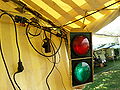
| Beschrijving | The network traffic light at haxogreen |
| Start | 2012-07-27 |
| Contact | Pietdv |
| Status | Production |
Because of a faulty switch the network at haxogreen 2012 was quite buggy for a while. After a couple of hours we were sick of opening up a terminal and starting a ping to check if the internet was up. We had a raspi and a traffic light available, so we started hacking. We made a little relay board to let the raspi control the traffic light, and wrote a shell script to check if there was an internet connection and set the traffic light to green if there was, to red if there wasn't.
http://www.youtube.com/watch?v=uxdJv-h0Fks
Update 28/07/12
We made a new relay board so we can control the two light independently, When the raspi is booting both lights are now off.
Update 28/07/12 nr2
We ported the code to Python. When there is only a limited amount of package loss, the lights now blinks.
People who helped
Gallery
-
-
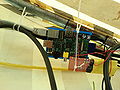 Raspberry PI with a relay board connected to it
 -
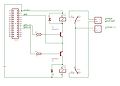 The schematic of the relay board


Script
#!/usr/bin/env python

"""
    A pure python ping implementation using raw socket.


    Note that ICMP messages can only be sent from processes running as root.


    Derived from ping.c distributed in Linux's netkit. That code is
    copyright (c) 1989 by The Regents of the University of California.
    That code is in turn derived from code written by Mike Muuss of the
    US Army Ballistic Research Laboratory in December, 1983 and
    placed in the public domain. They have my thanks.

    Bugs are naturally mine. I'd be glad to hear about them. There are
    certainly word - size dependenceies here.

    Copyright (c) Matthew Dixon Cowles, <http://www.visi.com/~mdc/>.
    Distributable under the terms of the GNU General Public License
    version 2. Provided with no warranties of any sort.

    Original Version from Matthew Dixon Cowles:
      -> ftp://ftp.visi.com/users/mdc/ping.py

    Rewrite by Jens Diemer:
      -> http://www.python-forum.de/post-69122.html#69122

    Rewrite by George Notaras:
      -> http://www.g-loaded.eu/2009/10/30/python-ping/

    Revision history
    22:16, 28 July 2012 (CEST)22:16, 28 July 2012 (CEST)22:16, 28 July 2012 (CEST)~

    November 8, 2009
    ----------------
    Improved compatibility with GNU/Linux systems.

    Fixes by:
     * George Notaras -- http://www.g-loaded.eu
    Reported by:
     * Chris Hallman -- http://cdhallman.blogspot.com

    Changes in this release:
     - Re-use time.time() instead of time.clock(). The 2007 implementation
       worked only under Microsoft Windows. Failed on GNU/Linux.
       time.clock() behaves differently under the two OSes[1].

    [1] http://docs.python.org/library/time.html#time.clock

    May 30, 2007
    ------------
    little rewrite by Jens Diemer:
     -  change socket asterisk import to a normal import
     -  replace time.time() with time.clock()
     -  delete "return None" (or change to "return" only)
     -  in checksum() rename "str" to "source_string"

    November 22, 1997
    -----------------
    Initial hack. Doesn't do much, but rather than try to guess
    what features I (or others) will want in the future, I've only
    put in what I need now.

    December 16, 1997
    -----------------
    For some reason, the checksum bytes are in the wrong order when
    this is run under Solaris 2.X for SPARC but it works right under
    Linux x86. Since I don't know just what's wrong, I'll swap the
    bytes always and then do an htons().

    December 4, 2000
    ----------------
    Changed the struct.pack() calls to pack the checksum and ID as
    unsigned. My thanks to Jerome Poincheval for the fix.


    Last commit info:
    22:16, 28 July 2012 (CEST)22:16, 28 July 2012 (CEST)22:16, 28 July 2012 (CEST)~~
    $LastChangedDate: $
    $Rev: $
    $Author: $
"""

import os, sys, socket, struct, select, time

# From /usr/include/linux/icmp.h; your milage may vary.
ICMP_ECHO_REQUEST = 8 # Seems to be the same on Solaris.

IP="8.8.8.8"
TIMEOUT=0.4
GREENPIN=24
REDPIN=23
HISTORY=10

def checksum(source_string):
    """
    I'm not too confident that this is right but testing seems
    to suggest that it gives the same answers as in_cksum in ping.c
    """
    sum = 0
    countTo = (len(source_string)/2)*2
    count = 0
    while count<countTo:
        thisVal = ord(source_string[count + 1])*256 + ord(source_string[count])
        sum = sum + thisVal
        sum = sum & 0xffffffff # Necessary?
        count = count + 2

    if countTo<len(source_string):
        sum = sum + ord(source_string[len(source_string) - 1])
        sum = sum & 0xffffffff # Necessary?

    sum = (sum >> 16)  +  (sum & 0xffff)
    sum = sum + (sum >> 16)
    answer = ~sum
    answer = answer & 0xffff

    # Swap bytes. Bugger me if I know why.
    answer = answer >> 8 | (answer << 8 & 0xff00)

    return answer


def receive_one_ping(my_socket, ID, timeout):
    """
    receive the ping from the socket.
    """
    timeLeft = timeout
    while True:
        startedSelect = time.time()
        whatReady = select.select([my_socket], [], [], timeLeft)
        howLongInSelect = (time.time() - startedSelect)
        if whatReady[0] == []: # Timeout
            return

        timeReceived = time.time()
        recPacket, addr = my_socket.recvfrom(1024)
        icmpHeader = recPacket[20:28]
        type, code, checksum, packetID, sequence = struct.unpack(
            "bbHHh", icmpHeader
        )
        if packetID == ID:
            bytesInDouble = struct.calcsize("d")
            timeSent = struct.unpack("d", recPacket[28:28 + bytesInDouble])[0]
            return timeReceived - timeSent

        timeLeft = timeLeft - howLongInSelect
        if timeLeft <= 0:
            return


def send_one_ping(my_socket, dest_addr, ID):
    """
    Send one ping to the given >dest_addr<.
    """
    dest_addr  =  socket.gethostbyname(dest_addr)

    # Header is type (8), code (8), checksum (16), id (16), sequence (16)
    my_checksum = 0

    # Make a dummy heder with a 0 checksum.
    header = struct.pack("bbHHh", ICMP_ECHO_REQUEST, 0, my_checksum, ID, 1)
    bytesInDouble = struct.calcsize("d")
    data = (192 - bytesInDouble) * "Q"
    data = struct.pack("d", time.time()) + data

    # Calculate the checksum on the data and the dummy header.
    my_checksum = checksum(header + data)

    # Now that we have the right checksum, we put that in. It's just easier
    # to make up a new header than to stuff it into the dummy.
    header = struct.pack(
        "bbHHh", ICMP_ECHO_REQUEST, 0, socket.htons(my_checksum), ID, 1
    )
    packet = header + data
    my_socket.sendto(packet, (dest_addr, 1)) # Don't know about the 1


def do_one(dest_addr, timeout):
    """
    Returns either the delay (in seconds) or none on timeout.
    """
    icmp = socket.getprotobyname("icmp")
    try:
        my_socket = socket.socket(socket.AF_INET, socket.SOCK_RAW, icmp)
    except socket.error, (errno, msg):
        if errno == 1:
            # Operation not permitted
            msg = msg + (
                " - Note that ICMP messages can only be sent from processes"
                " running as root."
            )
            raise socket.error(msg)
        raise # raise the original error

    my_ID = os.getpid() & 0xFFFF

    send_one_ping(my_socket, dest_addr, my_ID)
    delay = receive_one_ping(my_socket, my_ID, timeout)

    my_socket.close()
    return delay


def verbose_ping(dest_addr, timeout = 2, count = 4):
    """
    Send >count< ping to >dest_addr< with the given >timeout< and display
    the result.
    """
    for i in xrange(count):
        print "ping %s..." % dest_addr,
        try:
            delay  =  do_one(dest_addr, timeout)
        except socket.gaierror, e:
            print "failed. (socket error: '%s')" % e[1]
            break

        if delay  ==  None:
            print "failed. (timeout within %ssec.)" % timeout
        else:
            delay  =  delay * 1000
            print "get ping in %0.4fms" % delay
    print

def set_pin(pin,value):
    file('/sys/class/gpio/gpio'+str(pin)+'/value','w').write(str(value))

def blink_pin(pin,f):
    t=time.time()
    t=t-int(t)
    if t < 0.5:
      set_pin(pin,1)
    else:
      set_pin(pin,0)

def init_pin(pin):
  file('/sys/class/gpio/export','w').write(str(pin))
  file('/sys/class/gpio/gpio'+str(pin)+'/direction','w').write('out')

if __name__ == '__main__':
    count=0
    loss=0

    init_pin(REDPIN);
    init_pin(GREENPIN);

    while 1 == 1:
        lasttime=time.time()
        print time.time()
        if count>(HISTORY-1):
            count=count-1
            if loss>(HISTORY-1):
              loss=loss-1
        ping = None
        try:
          ping = do_one(IP,TIMEOUT)
        except:
          pass
        count=count+1
        if ping == None:
            loss=loss+1
        elif loss>0:
            loss=loss-1

        print "ping "+str(count)+", loss "+str(loss)
        if loss==0:
            set_pin(REDPIN,0)
            set_pin(GREENPIN,1)
        elif loss==count:
            set_pin(GREENPIN,0)
            set_pin(REDPIN,1)
        else:
            set_pin(GREENPIN,1)
            blink_pin(REDPIN,0.2+((1.0-(float(loss)/float(count)))/2.0))
        wait = lasttime+1 - time.time()
        print wait
        if loss==0 and wait:
           time.sleep(wait)